Implants Supported Bridge
Implants Supported Bridge in Morocco
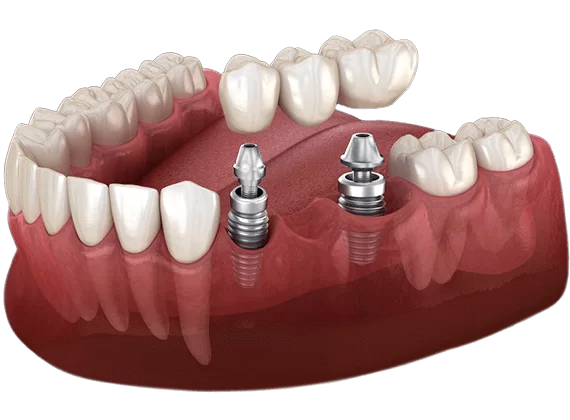
If you are missing 3 or more teeth on the upper or lower arch then having an Implant-Supported Bridge in Morocco may be a good choice for you. Implant-Supported Bridges are possible only between 2 or more Implants. An Implant cannot be used as part of a Bridge with a natural tooth.
Implants Supported Bridge allows a patient to regain an edentulous area with the least amount of Implants (Usually 2-3). We use Zirconia from Bruxir and Zirkhanzahn to give the needed strength for the Bridge. Shading and glaze techniques are applied for aesthetics, in some cases, a cap of porcelain is placed for better translucency.
Implants Supported Bridge FAQs
When 3 or more teeth are missing, decayed, or teeth with a bad prognosis, broken or cracked teeth, or root treatments that have failed consecutively in a row they can be removed and replaced with an implant-supported bridge, meaning 2 implants will be placed as anchors and a set of fused crowns will be fitted closing the gap and giving you a complete smile.
It is recommended to have the teeth extracted with our maxillofacial surgeon. In most cases the extraction and implant are done at the same time therefore you will be saving yourself additional costs and completing the treatment in a faster time frame.
To complete this treatment 2 trips are required. The first trip is the surgical stage where our highly experienced maxillofacial surgeon will extract your teeth if needed, place a bone graft and the implant with the help of surgical guidance. Normally a 5-day stay is suggested visiting the clinic an average of 3-4 times. Your second trip, 6 months later, is known as the restorative stage and a recommended stay of 7-10 days is required depending on how many crowns your bridge consists of.
For the best quality and long-lasting material, we would recommend a bridge made of Zirconia. This is a non-metal material that has the strength to support the force of the human bite. With proper cleaning and upkeep, this bridge will last you a lifetime.
Yes, this is very possible to have an implant-supported bridge. To give you the best possible success in treatment 3 implants may be placed instead of 2. This will prevent any weak spots on your bridge making sure it is stable throughout the entire length.
Placing implants will prevent bone loss and you will not have the fear of having that sunk-in look in the future. The bone integrates with the titanium implants to ensure the bridge is stable and fixed in place. Due to this integration, the bone remains at the desired level.
Thank you to our CAD/CAM technology and the well-trained eye of our dental technicians with the approval and guidance of Dr. Irma Gavaldon your bridge will look as natural as your adjacent teeth. Most patients also add whitening to their treatment, leaving home with a completely new beautiful bright smile.
The cost of the bridge will depend on how many teeth are missing and how many implants are required to support the bridge. For example, if 4 teeth are missing: 2 Titanium implants will be needed to support 4 zirconium crowns this will estimate an average cost of $3,900 USD. Keep in mind that we do not charge for consultation fees, X-Rays, additional materials used, lab fees, doctors’ fees, clinic fees, impressions, and modules, and your transport to and from all appointments. To provide you with a more detailed estimate please contact one of our dental coordinators by dialing the toll-free number below.
Dental Implants Pre-Op Instructions before coming to Agadir
Before surgery (three weeks)
Smoking and dental implants don’t go together. Smoking Is The Main Factor For Dental Implant Failure? We know smoking can be difficult to quit but we insist that patients stop smoking at least three weeks before their dental implants. On unusual occasions, we would ask you to stop smoking sooner, because it can interfere with your recovery, by reducing blood flow, which may prevent the incision from healing. We Highly Recommend You Quit Smoking Once You Commit To Your Dental Treatment
Before surgery (three weeks)
We know you will be on vacation and the all-inclusive bar might be tempting. You must stay away from any alcoholic beverage for a minimum of five days before your procedure. Alcohol causes increased bleeding, and the chances of infection, as well as depress immune functions and might interfere with wound recovery.
Before surgery (three weeks)
Please check with your physician about suspending any medication prior to arrival. We Have No Knowledge Of Your Medical History Prior To Your Arrival To Cancun It Is Very Important You Contact Once Of Our Dental Coordinator And Let Them Know What Medicines You Are Taking. Sometimes We Will Ask For A Letter From Your Physician To Suspend Certain Medication During Procedures Or Healing Process
Before surgery (three weeks)
It is essential that you maintain a healthy food plan. You will be on a soft mechanical diet or modified and adapted to your surgery, so you must follow these instructions. Get protein supplements like Ensure or Boost, as well as soft foods like well-cooked pasta, yogurt, eggs, broths, and soup. We will provide you with a list of dietary suggestions in your post-op packet as well.
Before surgery (three weeks)
- You must consult with your physician before discontinuing any medication.
- All anti-inflammatory drugs for arthritis (remember to consult your physician).
- Any kind of anti-coagulants.
- Vitamin E took internally.
- If you have any doubt about these medications, please contact us
Before surgery (two weeks)
During this period, we recommend you to take:
- A multivitamin tablet – daily (most multivitamins contain some form of vitamin E, however, this is suitable to take before surgery. We will ask to avoid taking any extra vitamin E).
- Vitamin A – twice a day: 8,000 to 10,000 units (this has well-documented beneficial effects on surgical healing and also will help your immune system).
- Vitamin C – two times a day: 1,000 mg (after your surgical procedure your need for vitamin C will increase, and it is important for collagen synthesis, which helps to wound recovery).
- Pineapple enzyme – twice a day (you find it on health food stores and it is a great help to relieve the swelling related to a surgical dental procedure. This anti-inflammatory promotes healing).
Before surgery: One week, until two weeks after surgery
You must eat:
- On each meal: a small amount of protein.
- Daily: three green vegetables and two fruits (according to diet instructions).
- Frequently: healthy meals.
IMPORTANT! Your food plan can useful resource for healing remarkably and decreasing swelling and pain.
Before surgery: One week
- You may begin taking a topical anti-inflammatory every eight hours as directed and continue for 10 days.
- Every 12 hours between meals, take pineapple enzyme as directed (it is an anti-inflammatory and helps to heal). Fresh pineapple is a good alternative.
Dental Implants Pre-Op Instructions before coming to Agadir
Standards of good oral hygiene are critical for the success and functionality of the implants and restoration. The best way to prevent infection and ensure healing is to keep your mouth clean. Clean your mouth thoroughly after each meal beginning the day after surgery. Use a soft-bristle toothbrush and toothpaste after meals and at bedtime. The use of a dental Waterpik is highly recommended to irrigate underneath the denture to flush out debris.
After a dental implant surgery is normally pink or blood-tinged saliva for two or three days and does not indicate any problem, even minimal bleeding is expected. In this case, the best way to stop it is by placing a damp piece of gauze and softly biting for 30 minutes while rest keeping your head elevated. In case the bleeding continues, repeat the gauze step for an additional 30 minutes. The suture material may last from two to three weeks, and you should not pull or cut the sutures by yourself.
After any surgery, swelling is a normal reaction of the body and the first step to healing. In the beginning, swelling will not become visible until 24 hours after your dental implant surgery, and couldn’t reach its peak for two or three days. After this period, the swelling decreases but may persist from seven to 10 days. You can minimize swelling by applying immediate ice packs to the outside of the face for 20 minutes on, and then 20 minutes off while awake for the first 24 hours.
First of all, remember that all medications must be prescribed and should not exceed the recommended dosage. Because most oral surgery is followed by some amount of discomfort, the surgeon may suggest taking any anti-inflammatory, non-steroidal medication (only if YOU ARE NOT ALLERGIC to it), before the local anesthetic wears off. In case of intense pain, you should require calm pain medication under prescription, which will cause you to feel drowsy, so you shall not operate any mechanical machinery or drive while taking the prescription. About the post-operative antibiotics, they must be taken as directed and the entire course of the prescription. For the first weeks after your dental implant surgery, you could also be prescribed an antibacterial mouth rinse which must be used two times a day.
We suggest starting with liquids, after a general anesthetic or conscious IV sedation, and must avoid hot meals or hot liquids while numb. The limited food intake that is required for the first days could be compensated by increasing the fluid intake, with high protein shakes to replace meal supplements. For the first six weeks you must follow a soft chew diet, so if you cannot cut easily any food, please avoid eating it.
48 hours after your dental implant surgery
For the first 48 hours after your dental implant surgery, you must rest and relax without any physical activity. After these 48 hours, you should resume activity as tolerated.
Eat:
- Gelatin
- Yogurt
- Pudding
- Cream of wheat / Oatmeal
- Mashed potatoes
- Soups
- Ice cream
- Cottage cheese
- Applesauce
- Scrambled eggs
- Fish
- Pasta (well-cooked)
- Pancakes
Drink:
- Water
- Popsicles
- Protein shakes / Smoothies
- Juice
- Milkshakes
When numbness is gone you can increase diet as tolerated by adding soft food
- Try to keep your lips moist with special ointments (such as Vaseline) to avoid the corners of your mouth drying and cracking.
- Sore throats and pain when swallowing are not uncommon. The muscles get swollen and the normal act of swallowing can become painful. This will subside in 2 to 3 days.
- Stiffness of the jaw muscles may cause difficulty in opening your mouth for a few days. Do not force your mouth open. Massage the muscles and apply moist heat.
- With upper jaw implant treatment, you may develop bleeding from the nose. This is usually a temporary finding and will not persist past 2 to 3 days. Avoid blowing your nose for several days.
- An appointment with your general dentist may be needed within a few days of surgery to make any adjustments to your temporary denture.
- Your case is individual as no two mouths are alike. Discuss all questions or concerns with your oral surgeon or implant coordinator.
Implants Supported Bridge Treatment Alternatives
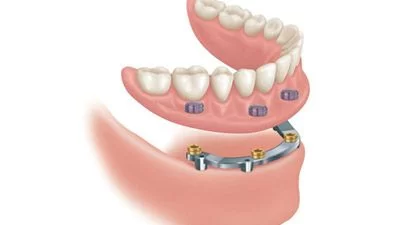
Fixed Hybrid Dentures are an ideal solution to Implant Supported Dentures. These Dentures can be used with as few as 4 Implants, keeping in mind that the more Implants the patient has, the better stability and load distribution the denture will have.
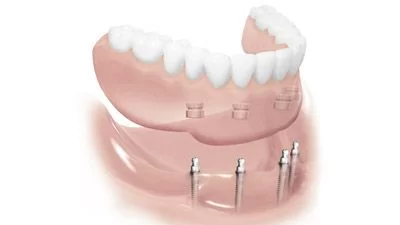
With the Snap-on Dentures, a patient will have the advantage of having a Fixed Restoration that they are able to give maintenance to themselves. Meaning no need for visits to the Dentist for periodic denture cleanings. Snap-on Dentures are used with a ball and housing concept.